January 2026
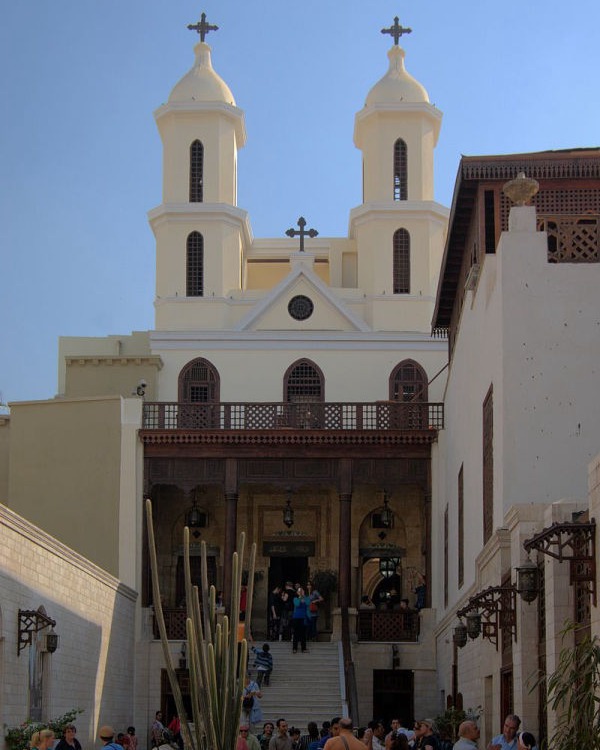
Our speaker gave us a fascinating exploration of Egypt from the splitting of the Roman Empire into its Eastern and Western domains in 395AD up to the arrival of the Arabs in 642AD and the subsequent establishment of Islam. A perhaps unfamiliar topic for those of us steeped in Pharaonic and Greco-Roman aspects of Egyptian history.
As the 4thC began the Roman Empire underwent a dramatic transformation when Emperor Diocletian, who had stabilised the Empire, decided to retire to his allotment to plant cabbages! His departure initiated a splitting of the Empire into Eastern and Western territories. Maximian/Augustus was appointed co-Emperor, reigning the Western Empire, whilst Diocletian retained authority of the Eastern Empire. A later division would see the establishment of a Tetrarchy, or "Rule of Four" comprising the two Augustae and two junior colleagues both referred as Caesar. Despite the effectiveness of the "Rule of Four" it finally collapsed due to competing dynastic claims. Theodosius reunited the Empire at the end of the 4thC, but after some 80 years it finally collapsed into the Eastern Empire, which became the Byzantine Empire and the Western, which became the Roman Empire under the father of Constantine. The territory of Egypt subsequently became home to mixed temples of varying groups including both Orthodox and Christians.
In 1945 the discovery of the Nag Hammadi Texts in Upper Egypt revealed the gospels of the Gnostics, written in the Coptic script, which shed light on the early Christians’ struggles to define Orthodoxy. In the 3rd Century a prophet from Persia, Mani, had proposed his own religion, Zoroastrianism, which comprised elements of Christian teaching alongside elements of religious teachings from India. We also learned that St. Augustin, a philosopher from Roman Africa who brought Christianity to England, was a follower of the Manichaeans.
Egypt itself was sitting on the edge of the Roman Empire and was ruled from Constantinople. Various Roman Emperors did visit Egypt including Vespasian, who visited Alexandria, Hadrian and his lover Antonius and finally Caracalla.
Michael went on to describe a Manichaean Quarter comprising an area of houses found in Kellis, near the Dakhla Oasis, which contained texts including prayers and rituals. The earliest surviving, purpose built churches were found here, oriented east/west, with the apse towards the east and including various ancillary rooms for the communities. Thus, around the 4thC, Egyptian religion existed in parallel to Christianity. Emperor Constantine tolerated this situation but began to provide further funding to build churches thus supporting the expansion of Christianity in Egypt. The monastic movement in Egypt began to take form around this time, notably with St. Anthony the Hermit supporting a new phenomenon, being the spread of monasteries in desert communities.
The last vestiges of Egyptian religion can be found at the Philae Temple, near Aswan in Upper Egypt. Here can be seen the last dated inscription in both Egyptian hieroglyphs and demotic. Following this demise came the arrival of the Coptic alphabet, which comprised predominately Greek signs and included some additional signs to encapsulate the range of sounds of the Egyptian language. Coptic was thus used for both the church and the civil administration and comprised a book or codex that could be copied, such as the Codex Glazier and used to support the bureaucracy.
Following the death of Theodosius in Alexandria the Greeks and Christians collaborated to destroy the Temple of Serapis and other key buildings such as the Serapeum and library complex.
In the 5thC, Christianity had spread further south from Egypt down to Ethiopia with its chief centre at Axum. Around this time a group of nomadic tribesmen, known as the Blemmyes, established a kingdom in lower Nubia. They showed similarities to folkloric images of the Middle Ages that depicted a mythical, headless man with his face on his chest!
Around this time a new Patriarch emerged in Alexandria, one St. Cyril of Alexandria. During his time the last pagan philosophers arose. Chief of these was the legendary female Neoplatonist philosopher, Hypatia. She had great support among both pagans and Christians and had great influence with the political elite in Alexandria. She was a mathematician and astronomer and is particularly notable for her use of the astrolabe to study the heavens. She was a close advisor to Orestes of Alexandria who was engaged in political dispute with the Bishop Cyril. He was known to be particularly stern and uncompromising and as a result of Hypatia's support of Orestes, he had her caught and killed in the marketplace by his Christian followers.
Further religious turmoil in the 5thC, lead to the establishment of four ecumenical church councils located first in Nicea then Constantinople, Ephesus and Calcedon who proposed a debate to conceptualise God as the Father, Son and Holy Spirit based on Greek philosophy. Cyril was in political dispute with the Patriarch of Constantinople, but following his death a compromise formula was established by the Council of Calcedon defining God as both fully God and fully human. This two natures concept led to a rift in the Church between Egypt and Constantine which resulted in a separate Coptic Church in Egypt headed by its own Pope. Many pagan sites and shrines were subsequently taken over and elaborate churches built at those sites. Notable examples include the Coptic church in the Temple of Dendera in Middle Egypt, the Coptic Monastery near the site of the workmen’s village in Deir el-Medina, the Red Monastery at Sohag and the St. Catherine monastery of Greek Orthodox monks in Sinai. In the 6thC Justinian imposed Christianity, finally ridding Egypt of paganism and closing the Temple of Philae in 530AD.
The 7thC heralded conflict between the Byzantines and the Sassanians of Persia which resulted in the Byzantines losing Egypt to the Persians. Despite being reconciled with the Byzantines, Byzantium finally lost Egypt in 639-642AD as a result of the Arab Conquest becoming majority Muslim.
June 2026
When our scheduled speaker, Dr Violaine Chauvet, was unfortunately unable to come at the very last minute, our ever-resourceful Chair, Dr Joanne Backhouse, saved the day by stepping in and delivering an excellent lecture she had been working on covering the principles of Egyptian art.
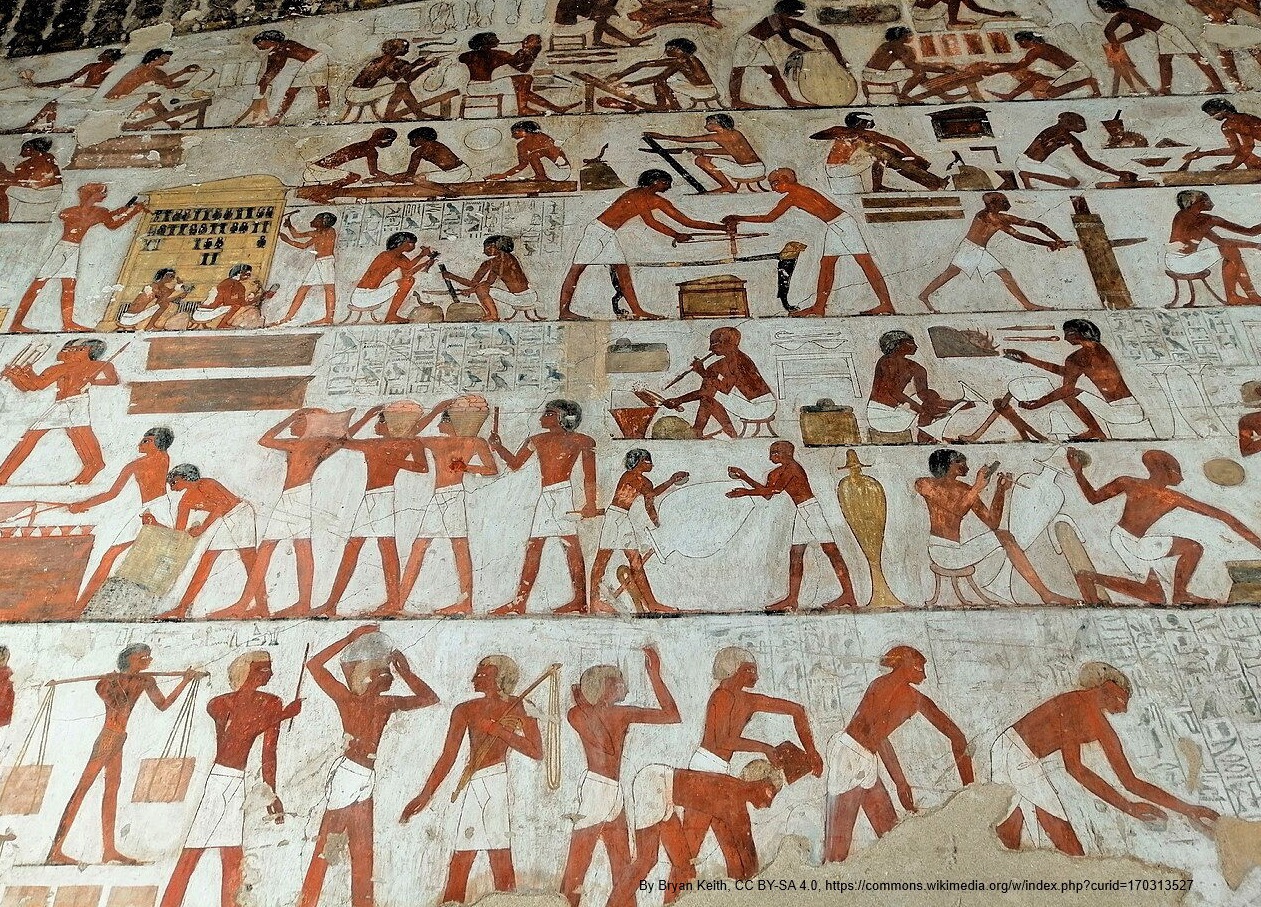
She started by introducing us to Dr Heinrich Schafer, Curator at the Berlin Museum between 1914 and 1935; a time when many big discoveries were being made in Egypt. He tried to make sense, for the general public, of the way in which Egyptian art was presented and wrote a book on the principles of Egyptian art from a theoretical stance, rather than just showing numerous illustrations. He identified that the Greeks in the 5th century BCE were the first to use techniques of foreshortening and perspective, which were game-changers in the aesthetic presentation of artworks. He described perspective as an illusion which distorts things and termed anything before this time Pre-Greek. This, of course, included Egyptian art. He described Egyptian art as functional, rather than aesthetic, and used the term aspective for it. The artist was not trying to portray what his eye could see, but rather what was in his mind. So a scene could contain different moments in time, different viewpoints and the contents of vessels and boxes might be shown above them, in order that the viewer would be in no doubt as to what they contained.
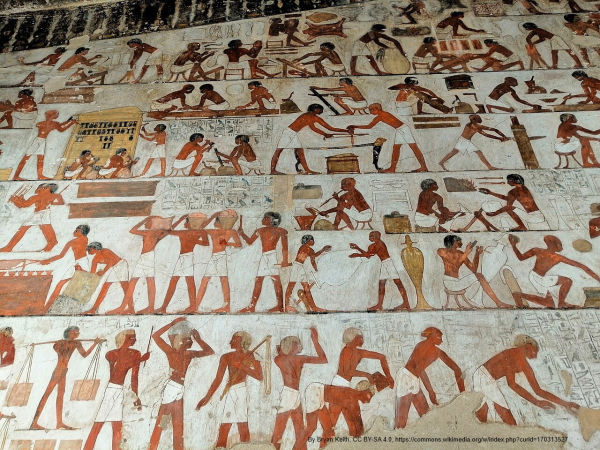
Schafer stated that the fundamentals of Egyptian art started to be formed about 2600BCE and adopted some techniques that had been used since Predynastic times, such as the use of registers. Throughout Egyptian history registers were of importance. However, some other elements used in Predynastic times fell away (though smiting scenes such as seen on the Narmer palette continued throughout). The tomb of Nebamun and Ipuky (TT181) is an excellent example of the fully formed principles of the art. This is the tomb of two sculptors, which shows scenes of craftsmen at their trades in a royal workshop. It is interesting to note that there is no single word for ‘art’, the closest is ‘craft’ which covers many types of creativity. Size is used as a sign of importance and status and one of the tomb owners is depicted sitting in front of the workers overseeing and inspecting their work. The workmen, in two registers before him, are considerably smaller in size. He also faces to the right, which was the prominent position in Egyptian scenes. The aspective nature of the work is clearly seen in examples such as the senet board being drawn on its side, so that the squares can be seen and its purpose is obvious to the viewer, the contents of a box are sitting above it and completed djed pillars, which have been finished (or perhaps are still to be made) are shown alongside the ones that are in the process of being crafted. The registers and other fundamentals form the instantly-recognisable strict framework and style of Egyptian art, but there is still scope for some individual expression and in the scene one of the workmen is a bit bald and has a pronounced paunch.
Rekhmire’s tomb (TT100) shows very clearly how the artisans worked collectively, rather than individually and those creating a statue demonstrate the link between 2 dimensional and 3 dimensional art, with the carving and the painting being unrealistically shown as happening at the same time. Artisans shown in tombs are all male, as any crafts completed by women would be undertaken in the home.
The early use of perspective and foreshortening is visible in the scene of Hades abducting Persephone from the Vergina royal tombs and the chariot appears to be heading straight at the viewer. In contrast, Tutankhamun’s painted chest is very different and purely aspective. He fills the centre of the scene, facing right, with registers of smaller neatly ordered Egyptian soldiers in their chariots behind him. Before him is a scene of utter chaos with no registers. The foreigners are being slaughtered by the Egyptians and are unnaturally contorted and even upside down, something dreaded by the Egyptians. Others are drawn frontally, which again is most unusual in Egyptian art. All of this is quite intentional to portray the theme, running throughout all periods of Egyptian history, of the king bringing chaos under control.
The Egyptian artists were very accomplished and would have been perfectly capable of using perspective had they had chosen to. But the strict standardisation suited the functional nature of their art and was essential on a practical level for enabling gangs working on different walls in the tombs in, for example, the Valley of the Kings, to be able to create matching scenes. Unfinished sections on the walls are extremely helpful to us in enabling us to see the various processes involved. To begin with a cord dipped in red paint was used to mark up a grid of the correct size on the surface. An outline of the image required was drawn, then corrected by the master artist, before blocks of colour were filled in and then finished by the application of an outline – very handy for giving the scene definition and hiding any slightly wobbly edges.
During the majority of the time, from the Middle Kingdom onwards, an 18 square grid was used; from the top of the head to the feet and giving ideal proportions, which were initially the prerogative of royalty, but then filtered down to non-royals. Any crowns or headgear would be above the top square. There was a simpler format in the Old Kingdom with horizontal lines, but only one vertical one. During Intermediate Periods the essence of the ideal proportions lessened as there were no dedicated royal workshops to observe the strict rules.
It is not only the proportions that make Egyptian figures instantly recognisable, but also the standard method of showing the head in profile, shoulders frontally and torso in three quarters view. The art also spilled over into the Egyptian writing with hieroglyphs being pictorial. For example the determinative for an official is a man holding a staff of office. In the Amarna period the grid changed to 20 squares with the extras being used for the neck and belly. In the 26th Dynasty archaising was a prominent feature and a 21 square grid was implemented to aid the artists in recreating the perfection achieved in previous golden ages of art.
Women and men were shown differently. The skin of men was a reddish brown, whilst women were much paler, reflecting the greater amount of time spent in the home. Children had the same gender colour as their parents. Men would be shown striding and active, whereas women would be standing passively with their feet together. The sexual characteristics of women were exaggerated to point to their important aspect of fertility and fecundity. A woman often had her hand around the back of her husband, showing support. Naked figures were unusual, though not unknown. A man undertaking dirty or wet work might be shown with no clothes. Or it may have been used to suggest the innocence of being reborn.
Statues were used as vessels for the ka, so sculptors were very important, and interestingly the adze was used to carve statues as well as being one of the instruments used in the opening of the mouth ceremony to reinvigorate the deceased. In addition the word for sculptor ‘gmwty’ also means to make live.
Some styles came and went over a short period, such as the fashion in the 5th and 5th Dynasties for statue groups with multiple representations of a person at different ages or different stages of his career.
The last aspect considered by Jo was the unusual and infrequent use of frontality making a striking statement, which we had already encountered on the Tutankhamun chest. It was seen in foreigners and also in the divine realm. Nut is frequently depicted frontally which makes it possible for us to see the passage of the sun through her body. She was often stretched over the inside of the coffin lid so that she was face to face with the deceased. She would also be depicted nude, very unusual for a goddess, but essential for her as she is going to be giving birth to the moon or the sun. This imagery of Nut ran right through to the 2nd century CE. The classic smiting pose would generally include some of the foreigners, clutched in the king’s fist, facing the viewer, with multitudinous numbers of captives to each side, giving an impression of layers and depth to emphasise the number of captives and prowess of the king.